



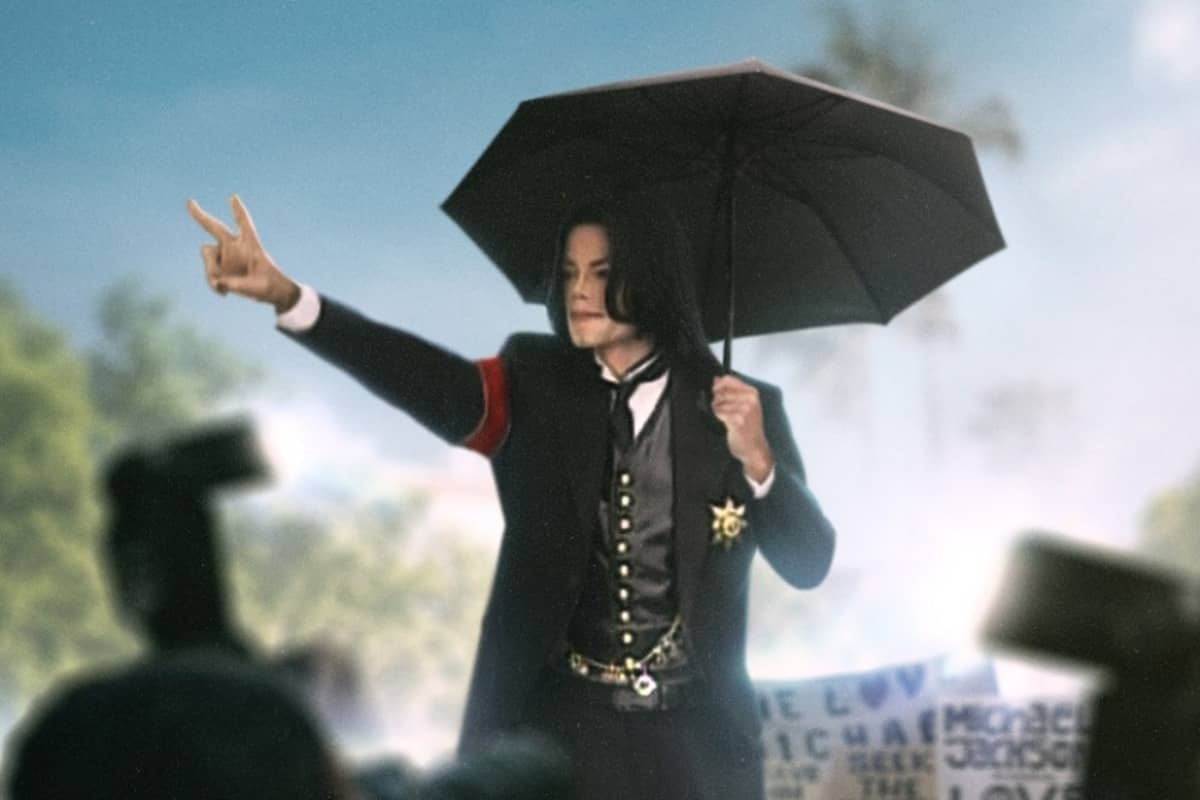
On June 3, 2026, Netflix released Michael Jackson: The Verdict, a three-part docuseries revisiting the singer’s 2005 child molestation trial. Jackson, who died in 2009, was acquitted on all 14 counts by a unanimous jury. He cannot defend himself. And Netflix is banking on that.
The series arrives weeks after the estate-approved biopic Michael, starring Jackson’s nephew Jaafar, grossed roughly $855 million worldwide. The timing is not subtle. What is being sold as journalism is, by the documented record, closer to recycled myth.
The Legal Record: Michael Jackson was acquitted on all 14 counts by a unanimous jury on June 13, 2005. The jury included members who initially leaned toward the prosecution. They changed their minds after seeing the evidence.
What the Media Reported vs. What Actually Happened in Court
Investigative journalist Charles Thomson spent years reviewing full court transcripts and comparing them to press coverage of the trial. His findings, published in the Huffington Post in 2010, are damning – not of Jackson, but of the media.
“Reading the court transcripts and comparing them to the newspaper cuttings,” Thomson wrote, “the trial that was relayed to us didn’t even resemble the trial that was going on inside the courtroom.”
The pattern was consistent throughout the trial: reporters rushed outside to broadcast the prosecution’s most graphic allegations and then missed the cross-examinations that dismantled them. As Fox columnist Roger Friedman explained at the time, “What’s not reported is that the cross-examination of these witnesses is usually fatal to them.”
Matt Drudge agreed during that same April 2005 interview: “You’re not hearing how witness after witness is disintegrating on the stand. There is not one witness, at least lately, that hasn’t admitted to perjuring themselves.”
The Accuser’s Testimony Fell Apart Under Cross-Examination
Gavin Arvizo, then 13, was the central accuser. His brother Star also testified. Both accounts were contradictory, and the press largely ignored this.
Star Arvizo gave two completely different descriptions of the same alleged act of molestation on consecutive days. Defense attorney Thomas Mesereau then showed him a copy of a magazine the boy claimed Jackson had shown him, and revealed it had been published five months after the Arvizo family left Neverland. That fact went almost entirely unreported.
Gavin Arvizo testified that Jackson told him all boys had to masturbate or they would become rapists, the supposed “grooming” act. Under cross-examination, he admitted his grandmother had made that comment, not Jackson. The cornerstone of the prosecution’s grooming narrative was built on a lie.
He also admitted under cross-examination that he had never felt afraid at Neverland and never wanted to leave, directly contradicting the prosecution’s kidnapping-and-conspiracy charge.
The Prosecution Tampered With Its Own Case
District Attorney Tom Sneddon, who had previously and unsuccessfully pursued Jackson in 1993, engaged in a series of legally questionable actions that received almost no press coverage.
- During the Neverland raid, Sneddon’s officers violated the terms of their own search warrant by entering Jackson’s office and seizing irrelevant business papers.
- They later illegally raided the office of a private investigator working for Jackson’s defense team, which a judge ruled was a clear breach of attorney-client privilege.
- Documents clearly marked for Jackson’s legal team were also seized from his personal assistant’s home.
- When Sneddon discovered taped interviews in which the entire Arvizo family praised Jackson and denied any abuse, he added a new kidnapping-and-conspiracy charge and claimed the family had been forced to lie.
- When Jackson’s then-attorney Mark Geragos announced on NBC that the singer had an airtight alibi, the indictment was reissued, with all dates shifted by nearly two weeks. The alibi ceased to exist.
- Sneddon was also caught seemingly attempting to plant fingerprint evidence during grand jury proceedings, by allowing Gavin Arvizo to handle adult magazines before they were sent for analysis.
The “Prior Victims” Were Not Victims
When the prosecution’s case began collapsing, the DA applied to introduce evidence of “prior bad acts.” The judge allowed five former alleged victims. Each case was weaker than the Arvizos’ claims.
| Name | What Happened |
|---|---|
| Wade Robson | Testified for the defense. Said Jackson never touched him. |
| Brett Barnes | Testified for the defense. Said Jackson never touched him. |
| Macaulay Culkin | Testified for the defense. Said Jackson never touched him. |
| Jason Francia | Said Jackson tickled him outside his clothes on three occasions. Police interview transcripts show he repeatedly changed his story and originally denied any molestation, until officers told him Jackson was currently molesting Macaulay Culkin and only Francia could stop it. |
| Jordy Chandler | Fled the country rather than testify. Mesereau said he had witnesses prepared to testify Chandler told them the abuse never happened. Chandler had legally emancipated himself from his parents. |
The disgruntled ex-employees who testified about alleged molestation had each been fired for theft or lost a wrongful termination lawsuit against Jackson. None had reported the supposed molestation to police when they claimed to witness it, not even during the 1993 Chandler investigation. They only mentioned it when tabloids began paying for stories. The more money on offer, the more graphic their accounts became.
What Happened After the Acquittal
When the jury returned 14 unanimous not-guilty verdicts, the media’s response was outrage, directed at the jurors.
- Nancy Grace appeared on CourtTV within minutes to suggest jurors had been seduced by Jackson’s fame.
- Wendy Murphy on Fox News called him “the Teflon molester” and said the jurors needed IQ tests.
- Jeffrey Toobin claimed on CNN that the “prior bad acts” testimony had been “effective evidence,” the same testimony that three of the supposed victims had given for the defense.
A post-verdict Gallup poll found 48% of the overall American population disagreed with the not-guilty verdicts. A People Weekly poll found 88% of readers disagreed with the jury’s decision. The media had done its work.
“The media did a number on its audience and it did a number on Jackson,” Thomson concluded. “Allegations disproven in court went unchallenged in the press. Shaky testimony was presented as fact. The defense’s case was all but ignored.”
What Netflix Is Now Doing
The Netflix docuseries does not introduce new evidence. It interviews attorneys, jurors, and witnesses, many of the same figures who have been making the same claims for two decades, and presents the acquittal as a puzzle rather than a verdict.
Audience reaction has been swift:
- An informal Rotten Tomatoes audience score of 8% was reported across social media.
- Calls to cancel Netflix subscriptions began trending immediately, including from Jonathan Moffett, Jackson’s longtime drummer.
- A viewer petition gathered tens of thousands of signatures within days of release.
The Jackson estate condemned the project. Under defamation law, however, the deceased cannot sue for slander in the United States, a legal reality Netflix’s production team is well aware of.
Michael Jackson was acquitted. Every major piece of testimony against him was either contradicted, retracted under cross-examination, or came from a witness with documented financial motives to lie. The documented record is not ambiguous. A docuseries that treats it as ambiguous is not journalism. It is exploitation of a man who cannot respond.
Primary Source
Charles Thomson — “One of the Most Shameful Episodes in Journalistic History”, originally published in the Huffington Post, June 25, 2010.
Full trial analysis and reporting portfolio: charles-thomson.net/Portfolio-Features-Michael-Jackson-Trial.html