
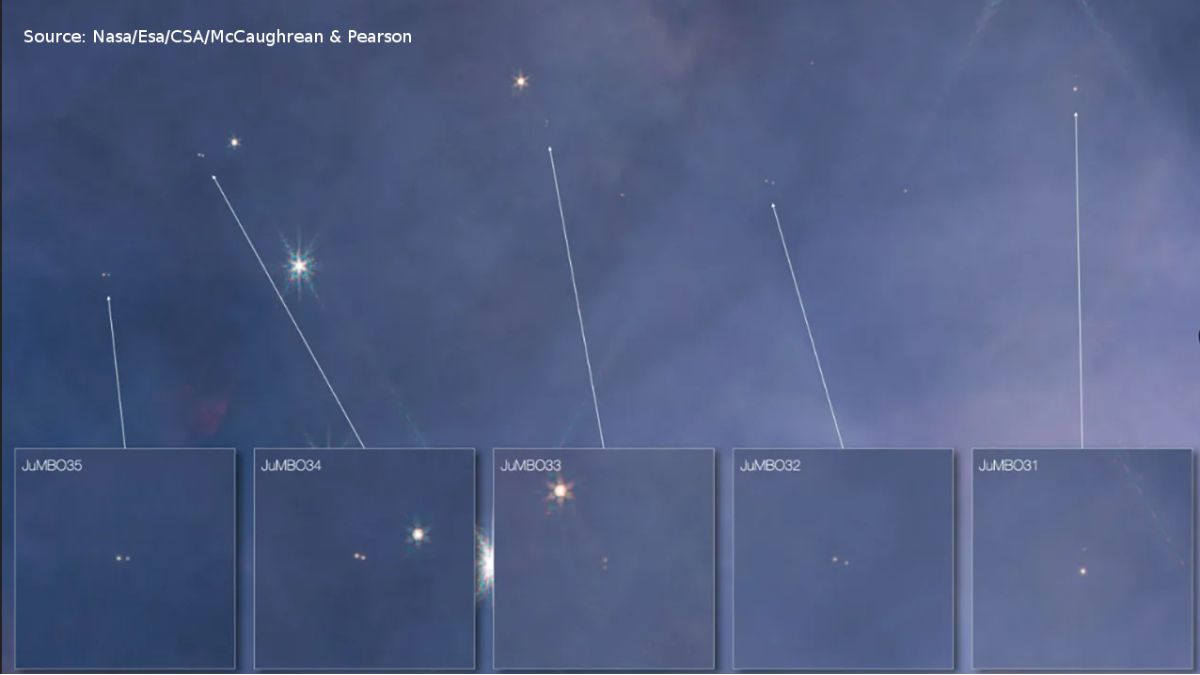
The James Webb Space Telescope (JWST) has discovered a new class of Jupiter-sized objects floating freely in space, unbound to any stars, according to astronomers and posts on social media platforms like X. These objects, called Jupiter Mass Binary Objects (JuMBOs), were observed in the Orion Nebula, roughly 1,350 light-years from Earth.
JWST identified about 40 pairs of JuMBOs in the star-forming region, with masses ranging from 0.7 to 13 times that of Jupiter. Most of these objects appear in pairs, orbiting each other at distances between 25 and 400 astronomical units.
Professor Mark McCaughrean, senior adviser at the European Space Agency (ESA), said, “Gas physics suggests you shouldn’t be able to make objects with the mass of Jupiter on their own… But how do you kick out pairs of these things together?”
Two main theories aim to explain their origin. One proposes JuMBOs formed like stars from collapsing gas and dust but lacked the mass to ignite nuclear fusion. The other, favored by McCaughrean, suggests they formed around stars and were later ejected by gravitational interactions, though the paired nature of the objects challenges this explanation. A 2024 study indicates such ejections are rare, occurring in less than 1% of simulations.
The JuMBOs are young, about one million years old, with surface temperatures near 1,000°C and atmospheres containing steam and methane, ruling out liquid water. Some recent research questions whether these objects are stable or even real, as simulations suggest 90% of pairs could break apart within a million years due to interactions with nearby stars.
The discovery, made using JWST’s NIRCam instrument and captured in a mosaic of 700 images, has astronomers excited and puzzled. Dr. Heidi Hammel described the find as “just so weird,” while online commentators have called JuMBOs a potential “crack in our cosmological scaffolding.” Scientists continue to study these rogue worlds as they challenge current ideas about star and planet formation.






 Follow on Google News