

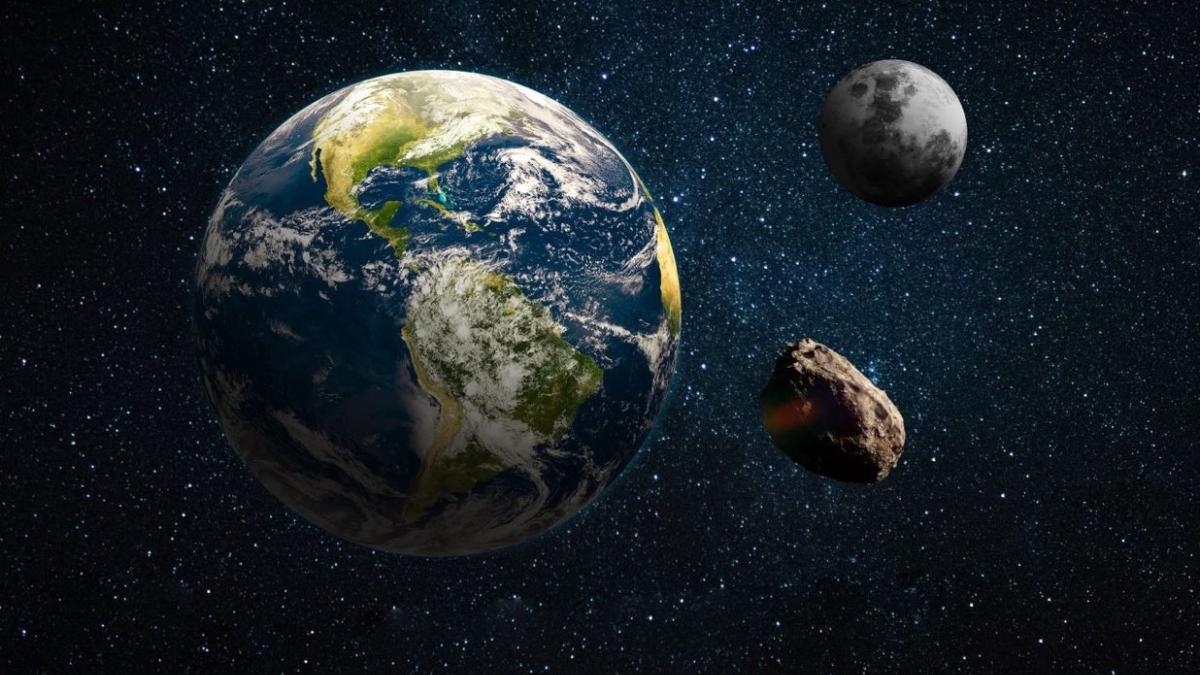
Astronomers have discovered a new space companion for Earth — a small asteroid named 2025 PN7, now confirmed as a “quasi-moon” that will orbit alongside our planet until around 2085.
The asteroid was first spotted this summer by Hawaii’s Pan-STARRS observatory, which searches for objects near Earth. It is about 62 feet (19 meters) wide — roughly the size of a six-story building.
Amateur astronomer Adrien Coffinet was among the first to notice its unusual orbit. He shared his findings on August 30, saying that 2025 PN7 “seems to be a quasi-satellite of Earth for the next 60 years.”
Further analysis published in the Research Notes of the American Astronomical Society confirmed that 2025 PN7 has been in this orbital pattern since around 1955 and will likely stay near Earth’s path until 2085.
Unlike the Moon, which is bound by Earth’s gravity, a quasi-moon moves around the Sun in almost the same orbit as Earth. From our point of view, it looks like it loops around the planet, but it is not actually captured by Earth’s gravity. Instead, it moves in a delicate balance — close to Earth but still orbiting the Sun.
At its closest, 2025 PN7 comes within about 2.5 million miles (4 million kilometers) of Earth. That’s much farther than the Moon’s average distance of 239,000 miles, but still close enough to make it an important discovery.
Scientists say 2025 PN7 is the smallest and least stable of Earth’s seven known quasi-moons. It is very faint, making it invisible to most amateur telescopes except during rare close passes.
The object joins a small group of similar companions, such as Kamoʻoalewa, which may be a piece of our own Moon, and several Arjuna-type asteroids that share Earth’s orbit.
NASA’s Jet Propulsion Laboratory (JPL) helped confirm the asteroid’s orbit with detailed tracking data, while the discovery credit goes to the University of Hawaii’s research team.
“This object reminds us that Earth’s orbit is more complex than it seems,” said a NASA spokesperson. “Quasi-moons show how dynamic and interconnected our solar system is. Even though 2025 PN7 won’t be visible to the naked eye, it tells us more about the near-Earth environment.”
For now, 2025 PN7 is moving away from Earth and won’t come close again until the 2030s. But scientists say it will remain our quiet companion in space for another 60 years, a gentle reminder that Earth’s path around the Sun is shared by many unseen travelers.







 Follow on Google News