
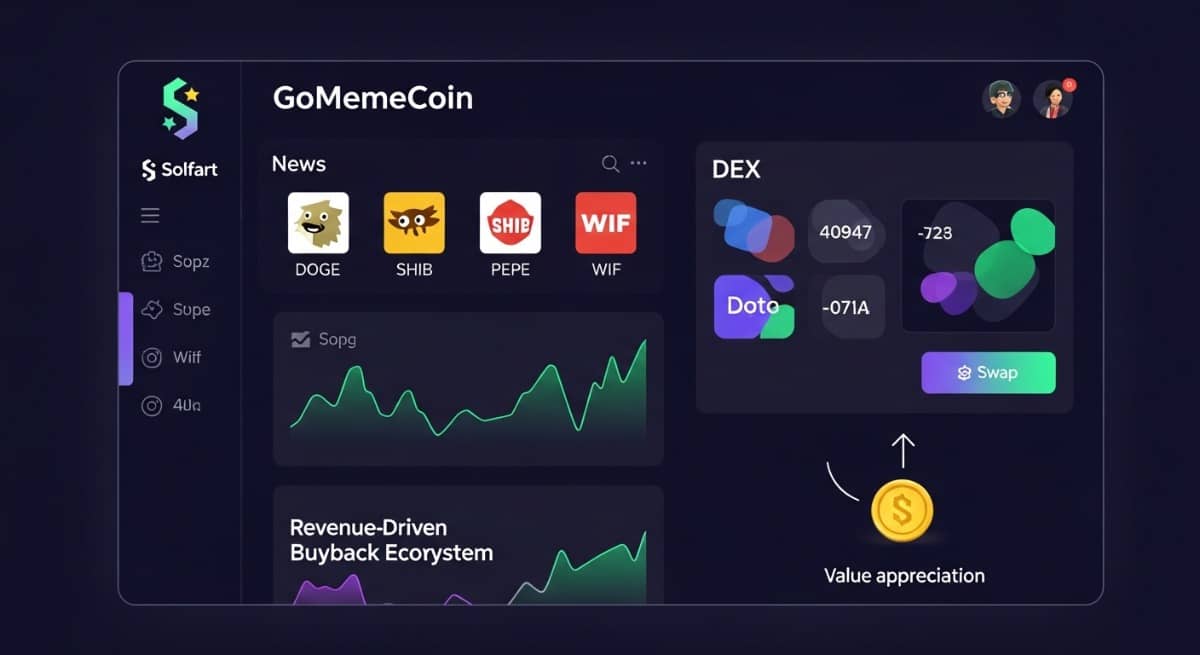
When Solfart ($SOLF) launched on the Solana network, it leveraged the viral nature of “toilet humor” to build a robust community. With figureheads like “Mark Zuckerfart” and “Fart McSatoshi,” the project satirized the often self-serious nature of the blockchain industry. Yet, beneath the jokes lay a serious ambition: to utilize the massive engagement of memecoins to build a self-sustaining financial machine.
The launch of GoMemeCoin represents the transition from Phase 1 (Community Building & Hype) to Phase 2 (Utility & Value Capture). The team recognized a gap in the market: while memecoins generate billions in trading volume, information about them is often scattered across disparate Discord channels, Reddit threads, and unverified Twitter posts.
GoMemeCoin aims to be the “Bloomberg of Memecoins”—a central hub where investors can find reliable, fast, and accurately formatted news about the volatile meme market, alongside updates on blue-chip assets like Bitcoin and Ethereum.
The Problem: Fragmented Information
In the current landscape, a memecoin trader often misses critical updates because news outlets either ignore smaller cap tokens or cover them too late. Conversely, purely “alpha” groups often lack editorial integrity. GoMemeCoin bridges this gap by applying professional journalistic standards to the wild west of memecoins.
The GoMemeCoin News Platform: Editorial Strategy
The immediate flagship of this launch is the GoMemeCoin news website. Unlike a standard blog, this platform is designed with the specific goal of achieving Google News indexing, a rigorous process that requires high-quality, original reporting, transparency, and authoritative sourcing.
1. Rapid-Fire, High-Frequency Reporting
The crypto market operates 24/7, and information asymmetry is the trader’s biggest enemy. To combat this, GoMemeCoin has assembled a dedicated editorial team of two senior writers and supporting analysts. The operational mandate is aggressive:
- Update Frequency: News updates will be published every few hours, ensuring that the platform remains a “live” feed of market sentiment and hard news.
- Coverage Spectrum: While the outlet will be highly focused on memecoin-related news (launches, rugs, pumps, community takeovers), it will maintain a holistic view of the market. Major updates regarding Bitcoin (BTC), Ethereum (ETH), and Solana (SOL) will be covered to provide context for broader market movements.
2. Targeting Google News Standards
To ensure the platform becomes a trusted source of traffic—and by extension, ad revenue—the content strategy is strictly aligned with Google Publisher Center guidelines.
- Structured Data: Articles will utilize correct schema markup to ensure visibility in rich snippets.
- Author Transparency: Every piece of content will feature clear bylines, author bios, and contact information, moving away from the anonymity often found in crypto blogs.
- Originality: The focus is on original analysis and breaking news, rather than syndicating content from other feeds.
By securing a spot on Google News, GoMemeCoin aims to capture organic traffic from outside the immediate crypto bubble, bringing mainstream eyes to the Solfart ecosystem.
The Economic Engine: Ad Revenue Buybacks & Burns
The most revolutionary aspect of the GoMemeCoin launch is its tokenomic integration with $SOLF. Most media outlets in the crypto space retain their profits or distribute them to equity shareholders. GoMemeCoin flips this model: the platform’s success is directly tied to the scarcity of the $SOLF token.
How the Mechanism Works
- Traffic Generation: As the news site publishes high-frequency, high-quality content, it attracts organic traffic from Google, social media, and the Solfart community.
- Monetization: This traffic is monetized through a combination of programmatic advertising (banners), sponsored articles, and strategic partnerships.
- Revenue Collection: Income from these sources is collected in a designated treasury wallet.
- The Buyback: This revenue is used to purchase $SOLF tokens directly from the liquidity pool. This creates constant buy pressure on the chart, independent of speculative trading volume.
- The Burn: The purchased tokens are sent to a “dead” address (burned), permanently removing them from the circulating supply.
Why This Matters for Investors
In traditional stock markets, share buybacks are a method companies use to return value to shareholders. In crypto, this is often mimicked but rarely backed by external revenue; usually, projects just burn tokens from a reserve they already hold (which doesn’t affect price).
The GoMemeCoin model is different because it uses external liquidity (fiat or stablecoins from advertisers) to buy tokens off the market. This creates a deflationary feedback loop:
Transparency First: The Revenue Dashboard
Trust is the most valuable currency in the crypto sphere. To prevent the skepticism that plagues many “revenue share” projects, Solfart is introducing a Public Revenue & Transparency Dashboard.
This dashboard will be a live, on-chain verifiable interface accessible via the GoMemeCoin website.
Dashboard Features:
- Weekly Revenue Reports: Every week, the dashboard will update to show exactly how much revenue was generated by the news platform. This includes a breakdown of programmatic ad revenue vs. direct sponsorships.
- Wallet Tracking: Users can view the treasury wallet address to verify the funds are actually there.
- Burn Verification: The dashboard will link directly to the transaction hashes (TXIDs) of the buyback and the subsequent burn, allowing any user to verify on the Solana blockchain that the tokens were indeed destroyed.
“We believe that if we say we are using revenue to burn tokens, the community shouldn’t just take our word for it—they should be able to see the dollars entering the wallet and the tokens leaving existence,” said a lead developer from the Solfart team.
Operational Efficiency: The Monthly Burn Strategy
While the news updates are frequent (every few hours) and the revenue tracking is weekly, the actual execution of the token burn will occur on a monthly basis.
The Logic Behind Monthly Burns
The decision to burn monthly rather than weekly or daily is a strategic one, designed to maximize impact and efficiency:
- Mitigating Volatility: Weekly burns can sometimes be absorbed by normal market volatility, making them feel insignificant. A larger, accumulated monthly buyback creates a noticeable “green candle” event on the chart, generating hype and marketing momentum.
- Gas & Operational Efficiency: Consolidating transactions reduces administrative overhead and gas fees, ensuring that a higher percentage of the revenue actually goes toward destroying tokens rather than paying network costs.
- Eventizing the Burn: The monthly burn will be treated as a community event. The “Solfart Burn Day” will become a recurring date on the calendar where the community can anticipate the reduction in supply, fostering a monthly cycle of engagement and anticipation.
The Future: GoMemeCoin Decentralized Exchange (DEX)
While the news platform is the immediate launch, it is the precursor to a larger infrastructure project: the GoMemeCoin DEX.
The current decentralized exchange landscape on Solana is dominated by giants like Raydium and Jupiter. However, the Solfart team sees an opening for a Meme-Centric DEX—an exchange optimized specifically for the high-velocity, high-risk nature of memecoin trading.
Planned Features of the Coming DEX:
- Curated “Safety” Zones: Unlike open DEXs where rug pulls are rampant, the GoMemeCoin DEX plans to feature a “Verified Zone” for projects that have passed specific audits or hold stringent liquidity locks.
- Integrated News Feed: The news platform will be directly integrated into the trading interface. When a user is trading a specific coin, they will see the latest news headlines regarding that asset in the sidebar, allowing for informed, split-second trading decisions.
- Expanded Burn Utility: Once the DEX is live, a portion of the trading fees generated by the exchange will also be funneled into the $SOLF buyback and burn protocol, adding a second stream of revenue to the deflationary engine.
Competitive Analysis: Solfart vs. The Field
The memecoin market is saturated with tokens that rely solely on “community vibes” and Ponzi-like mechanics. Solfart is differentiating itself by adopting the business model of a media conglomerate.
| Feature | Typical Memecoin | Solfart ($SOLF) Ecosystem |
| Primary Value Driver | Hype & Speculation | Hype + Ad Revenue + Trading Fees |
| Token Supply | Static or Inflationary | Deflationary (Active Burns) |
| Utility | None (Purely speculative) | Media Platform & DEX Access |
| Transparency | Vague “Marketing Wallet” | Public Revenue Dashboard |
| Information Flow | Telegram Rumors | Professional News Outlet |
The “Google News” Moat
By targeting Google News compliance, GoMemeCoin is building a “moat” around its business. Getting approved as a Google News publisher is difficult; it requires technical expertise, consistent editorial quality, and history. Once achieved, it provides a stream of “Web2” traffic that most crypto projects never access. This traffic is valuable to advertisers, which in turn makes the $SOLF burn mechanism more potent.
A New Paradigm for Meme Assets
The launch of GoMemeCoin marks a maturity point for the Solfart project. It is an acknowledgment that while “fart” jokes may capture attention, sustainable economics retain retention.
By building a professional-grade news outlet, ensuring editorial rigor that rivals traditional finance media, and mathematically tying the success of that platform to the value of the $SOLF token, the team is creating a hybrid asset. $SOLF is no longer just a meme coin; it is a revenue-backed deflationary asset powered by the attention economy.
As the first monthly burn approaches and the transparency dashboard goes live, the crypto world will be watching. If Solfart can successfully translate ad impressions into token scarcity, it may very well set the blueprint for how memecoins survive and thrive in the future.






 Follow on Google News