

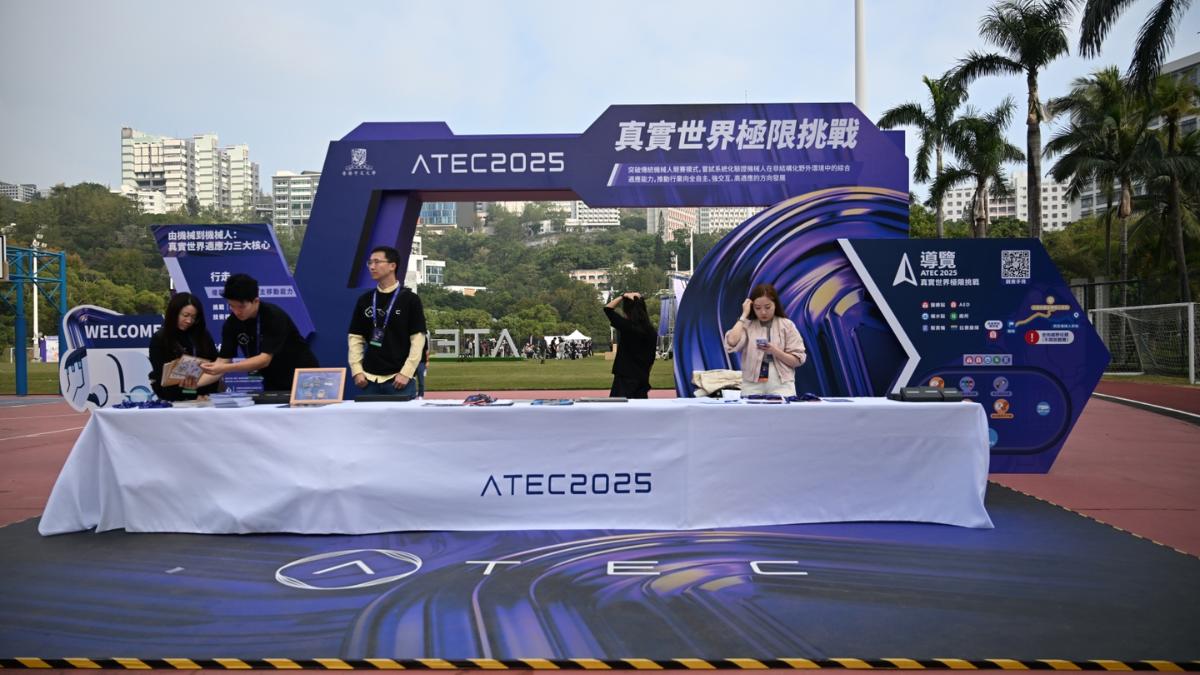
Robots competed in harsh outdoor conditions at the ATEC2025 Real-World Extreme Challenge, held at The Chinese University of Hong Kong. The event tested how well robots can operate outside controlled laboratory settings.
Professor Yunhui Liu, Co-Chair of ATEC2025, said the goal was to see if robots can “leave the lab and adapt to our unpredictable world.” The competition was supported by Ant Group, which believes future artificial intelligence should be closely integrated with the physical world.
Out of 392 teams worldwide, 13 advanced to the two-day final. The teams faced four tasks: waste sorting, autonomous plant watering, field orienteering, and bridge crossing. These challenges tested what Liu calls the “Three Core Capabilities of Robotics”: locomotion, manipulation, and environmental modification.
The competition was difficult, with many robots struggling on even basic tasks. Liu said failure is normal and expected. “What matters is progress. Some teams completed tasks after repeated trials,” he noted.
ATEC2025 emphasises real-world performance over polished demonstrations. Liu explained that online videos often show edited highlights, hiding repeated failures. The competition’s uneven terrain and obstacles exposed the robots’ true limits.
While the winning team will receive $150,000, the primary aim is to advance robotic intelligence. Liu said fully reliable robots for complex tasks, such as cooking or laundry, are still years away. Even completing 20–30% of basic human tasks consistently would be transformative.
By testing robots in realistic conditions, ATEC2025 sets new benchmarks for embodied AI. With backing from academia, industry, and the public sector, the event could become a recurring platform for developing intelligent machines capable of real-world tasks.






 Follow on Google News