

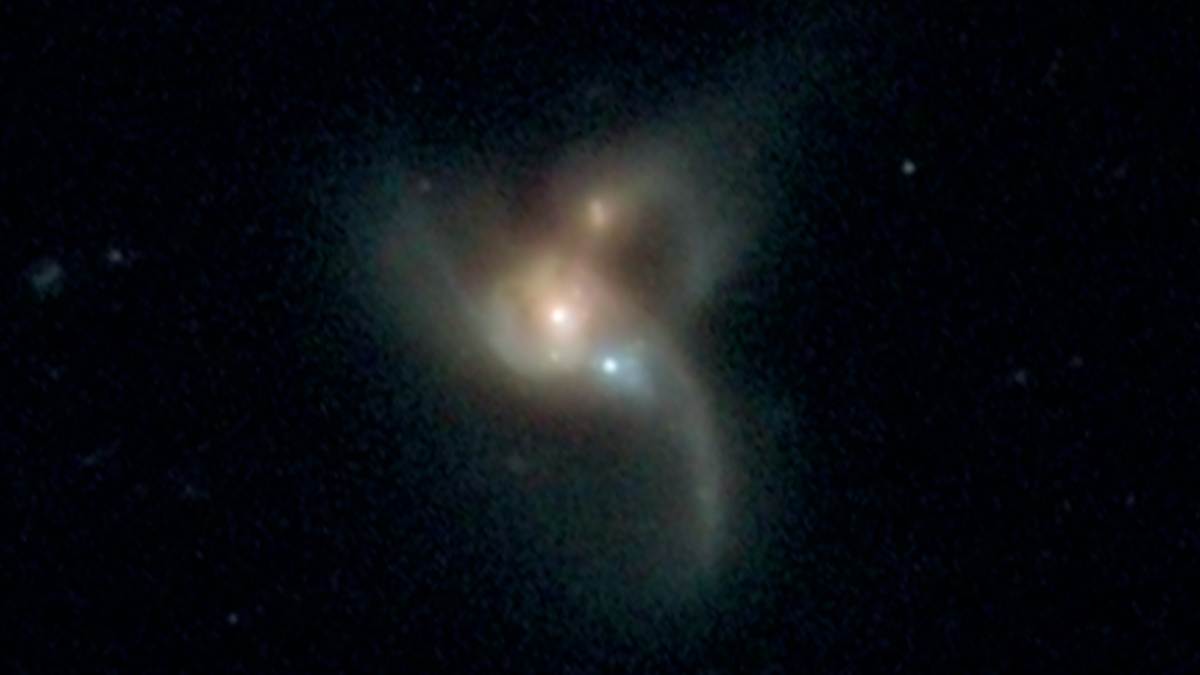
Astronomers have confirmed the first known “triple radio AGN” system, where three merging galaxies each host an actively feeding supermassive black hole, all emitting powerful radio waves at the same time.
The system, known as J1218/1219+1035, was identified by a research team led by Dr. Emma Schwartzman of the U.S. Naval Research Laboratory. The findings were published in The Astrophysical Journal Letters in late 2025 and early 2026.
While galaxy mergers are common, triple mergers are extremely rare, and it is even rarer to find all three black holes in an active state. In most mergers, at least one black hole remains dormant. In this case, gas is flowing into all three cores at once.
The system is located about 1.2 billion light-years from Earth. Astronomers observed long tidal tails of gas and stars, confirming the galaxies are physically connected and interacting.
Using high-resolution data from the Very Large Array (VLA) and Very Long Baseline Array (VLBA), researchers identified three distinct radio-bright cores. Two of the black holes are separated by about 22,000 light-years, while the third sits roughly 97,000 light-years away.
The active black holes are pulling in gas and dust, forming active galactic nuclei (AGN). As the material heats up, the black holes eject powerful jets of plasma moving near the speed of light, which produce the radio signals detected by astronomers.
Over millions of years, the galaxies and their black holes will continue to merge. Eventually, the three black holes are expected to form a chaotic system and combine into a single, more massive black hole, releasing gravitational waves in the process.
Scientists say the discovery offers a rare look at hierarchical galaxy evolution, helping explain how massive galaxies and black holes grew over cosmic time and how black hole activity influences star formation.






 Follow on Google News